
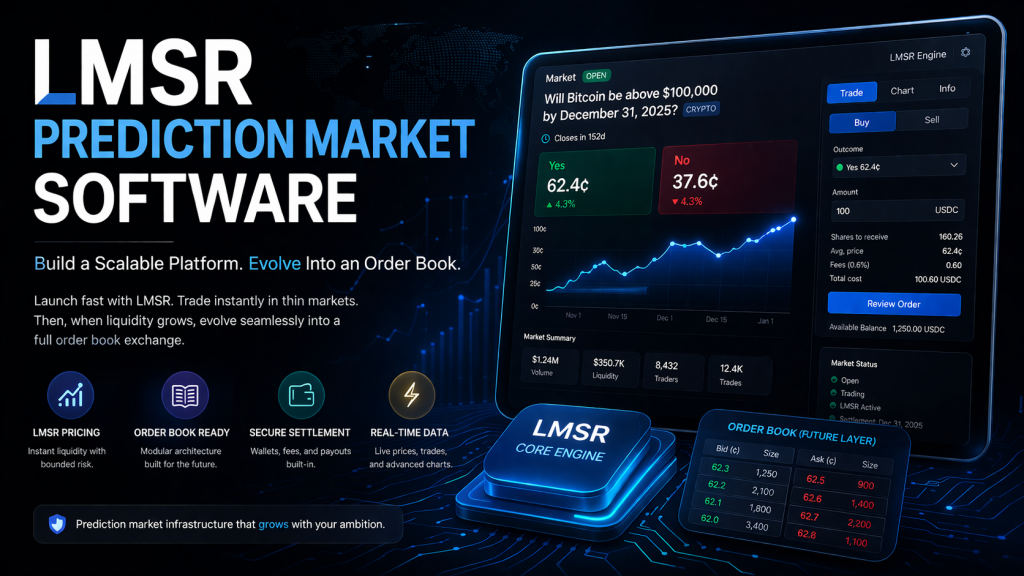
Prediction market software is not just a pricing formula. It is a full platform: market creation, outcome modeling, trade execution, wallet handling, settlement, real-time updates, charting, and operator workflows.
For most new platforms, LMSR prediction market software is the best place to start. It allows users to trade immediately without requiring deep order-book liquidity on day one. The smarter architectural move is not choosing between LMSR and an order book forever. It is launching with LMSR while designing the system so the platform can later evolve into an order-book prediction market when liquidity, trade frequency, and user sophistication justify the added complexity.
If you want to build serious prediction market software, understanding the LMSR formula is not enough. What matters is the full product architecture behind it: pricing, execution, fee handling, wallet logic, settlement, APIs, charting, and operational tooling. That is where most weak projects fail. They treat market design like a math problem when it is really a platform design problem.
What Is Prediction Market Software?
Prediction market software is the infrastructure that allows users to trade on the outcome of future events. Those events can include elections, sports, economic releases, asset-price thresholds, product launches, weather outcomes, or other measurable future states.
In a real platform, prices are not decorative percentages. They act as live probability signals shaped by trading activity. That means a production-grade system needs much more than a front-end interface. It needs market definitions, outcome structures, pricing logic, execution controls, fee accounting, trade history, settlement, refunds, analytics, and admin operations.
This distinction matters because many teams ask the wrong first question: “Should we use LMSR or an order book?”
The better question is: “How do we launch quickly with reliable liquidity, while keeping the platform structurally ready for more advanced market mechanics later?”
For many early-stage products, the answer is LMSR first.
Why LMSR Is Such a Strong Starting Point
LMSR, or Logarithmic Market Scoring Rule, is one of the most practical market-maker designs for early-stage prediction markets. It gives operators an always-on pricing mechanism that does not depend on having a deep pool of counterparties posting orders.
That makes LMSR especially useful for:
- new markets
- niche categories
- low-liquidity environments
- early-stage B2B deployments
- white label prediction market products
In practical terms, LMSR lets users trade immediately against the mechanism, while the platform continuously updates implied probabilities as inventory shifts across outcomes. That solves one of the hardest zero-to-one problems in market design: making a new market feel tradable before there is enough natural order flow.
This is why LMSR prediction market software is often the smartest launch strategy. You do not need deep liquidity on day one. You do not need market makers constantly managing quotes. You do not need users waiting for counterparties before activity begins. You can open the market, accept trades, update probabilities, and create visible movement immediately.
LMSR Is Not Just a Formula. It Is a Launch Strategy.
A lot of technical discussions reduce LMSR to an equation. That misses the real value.
LMSR is not just a pricing model. It is a launch strategy for prediction market platform development.
It helps operators:
- reduce early liquidity friction
- simplify execution
- accelerate MVP launch
- validate market demand faster
- avoid premature order-book complexity
That does not mean LMSR is always the final form of the platform. It means LMSR is often the best mechanism for getting a market from zero to usable.
The strongest architectural decision is usually not “LMSR forever” or “order book from day one.”
It is this:
Start with LMSR. Design for order-book migration.
What Production-Ready Prediction Market Software Actually Includes
This is where many articles stay vague. A real prediction market platform is not just an interface with percentages moving on the screen. It needs a set of core modules working together reliably.
1. Market and Outcome Models
The platform needs a clear market domain layer: markets, outcomes, market states, expiry logic, visibility rules, grouping logic, and resolution states.
This layer defines what can be traded, what users can hold, and how a market moves from open to locked, canceled, or resolved.
2. LMSR Pricing Engine
A serious LMSR prediction market software system needs a dedicated pricing layer that calculates:
- implied probabilities
- trade previews
- fees
- slippage
- average entry price
- cost changes after execution
- expected payout if correct
This logic should be isolated from the UI so the platform remains maintainable and future-proof.
3. Trade Execution and Risk Controls
Execution is where weak systems break.
A real platform needs to validate incoming trade requests, apply locking or idempotency controls, charge balances safely, write immutable trade records, update user positions, and recover cleanly from errors.
If real balances are involved, execution discipline is not optional. Without proper locking, request protection, and rollback handling, the platform becomes unreliable very quickly.
4. Wallet, Fee, and Settlement Logic
This is the part many low-quality products ignore.
A production-ready system needs:
- wallet charging
- fee accounting
- payout handling
- refunds on canceled markets
- auditable settlement history
- clear user-level position accounting
Without this layer, the product is not infrastructure. It is only a demo.
5. API Layer
A reusable API is what turns a one-off interface into real platform infrastructure.
It allows the same core system to power:
- web applications
- mobile applications
- admin consoles
- partner-specific front ends
- future white-label deployments
If you want to sell prediction market software as a product rather than a one-time build, the API layer matters.
6. Real-Time Updates and Charting
Prediction markets feel alive when users can see movement.
Live probabilities, recent trades, chart updates, and market-state changes are not cosmetic features. They improve trust, increase engagement, and make the product feel active even in smaller markets.
7. Operator and Admin Workflows
A serious white label prediction market platform needs internal tooling for operators.
That usually includes:
- market creation
- outcome management
- visibility controls
- market locking
- resolution workflows
- moderation controls
- content operations
If every market change requires engineering intervention, the product will struggle operationally.
How to Design an LMSR Platform That Can Later Evolve Into an Order Book
The biggest mistake many teams make is launching with LMSR but designing the product so tightly around LMSR that future evolution becomes painful.
That is avoidable.
If the platform is designed properly, the following layers should survive a later migration:
- market definitions
- outcome structures
- user positions
- wallet systems
- fee accounting
- settlement logic
- trade history
- chart history
- operator workflows
- APIs
What changes later is mainly the market interaction engine.
In an LMSR-based launch:
- users trade against automated market inventory
- prices are generated algorithmically
- execution is immediate
- there is no dependency on deep bid/ask liquidity
In a later order-book model:
- users place orders
- orders generate fills
- matching logic becomes central
- bid/ask depth matters
- partial fills appear
- liquidity-provider workflows become important
That is the strategic bridge founders should understand.
You are not rebuilding the business domain. You are swapping the interaction model.
That is why the best early architecture is not just “LMSR.” It is LMSR with order-book readiness.
LMSR vs Order Book: Which One Is Better?
The honest answer is: it depends on the stage of the platform.
If you are launching a new product, validating a niche, bootstrapping liquidity, or selling a white label prediction market solution to clients without an established trader base, LMSR is usually the better choice.
It is:
- faster to launch
- easier to manage
- better suited for thin markets
- more forgiving in early-stage environments
If you already have deep liquidity, active traders, tighter competition, and enough market activity to support continuous matching, an order book may become the stronger long-term structure.
That is where features like these start to matter more:
- price-time priority
- visible depth
- tighter spreads
- partial fills
- liquidity-provider behavior
- advanced trading workflows
So the right conclusion is not ideological. It is operational:
Use LMSR for launch speed and early usability. Use an order book when liquidity and market maturity justify the complexity. Build the platform so both paths remain open.
What White Label Prediction Market Really Means
A white label prediction market is not just a branded front end.
A real white-label product lets operators launch their own market experiences on top of the same infrastructure while controlling:
- branding
- categories
- workflows
- permissions
- fee logic
- moderation rules
- deployment patterns
- user experience
That is why modular architecture matters so much.
If your pricing engine, execution layer, APIs, admin tools, and settlement logic are cleanly separated, you are not just selling custom development. You are building reusable market infrastructure.
That is a much stronger business model.
Who This Type of Platform Is For
This kind of prediction market platform development is typically relevant for:
- startups building prediction products
- media companies adding interactive forecasting markets
- communities running opinion or event markets
- research or internal forecasting teams
- B2B buyers looking for white label prediction market software
- founders who want an MVP now but do not want to block future order-book evolution
If the goal is to launch quickly, validate demand, and keep strategic flexibility, LMSR-first architecture is usually the right call.
Final Thoughts
If you are building prediction market software, the smart move is not to treat LMSR as a narrow mathematical trick.
Treat it as the best practical starting point for launching a market that is tradable before liquidity is deep.
LMSR works because it lowers friction. It lets users trade immediately. It helps a platform feel alive sooner. It reduces the operational burden of running an order book too early. And when it is paired with a modular architecture, it gives operators something even more valuable: a realistic path from MVP to scale.
That is the real promise of modern prediction market platform development:
- start with LMSR
- separate pricing from execution
- build reliable wallet and settlement flows
- expose reusable APIs
- support operator workflows
- stay ready for order-book evolution
That is how you build a platform that is not just launchable, but scalable, sellable, and strategically defensible.
