
Prediction markets are no longer a niche curiosity. In April 2026, Fox announced that it would integrate Kalshi prediction market data across its news platforms, while multiple U.S. court battles around Kalshi highlighted how active—and how strategically important—the category has become. That matters for founders, operators, and B2B buyers: the market is alive, but the infrastructure has to be designed carefully.
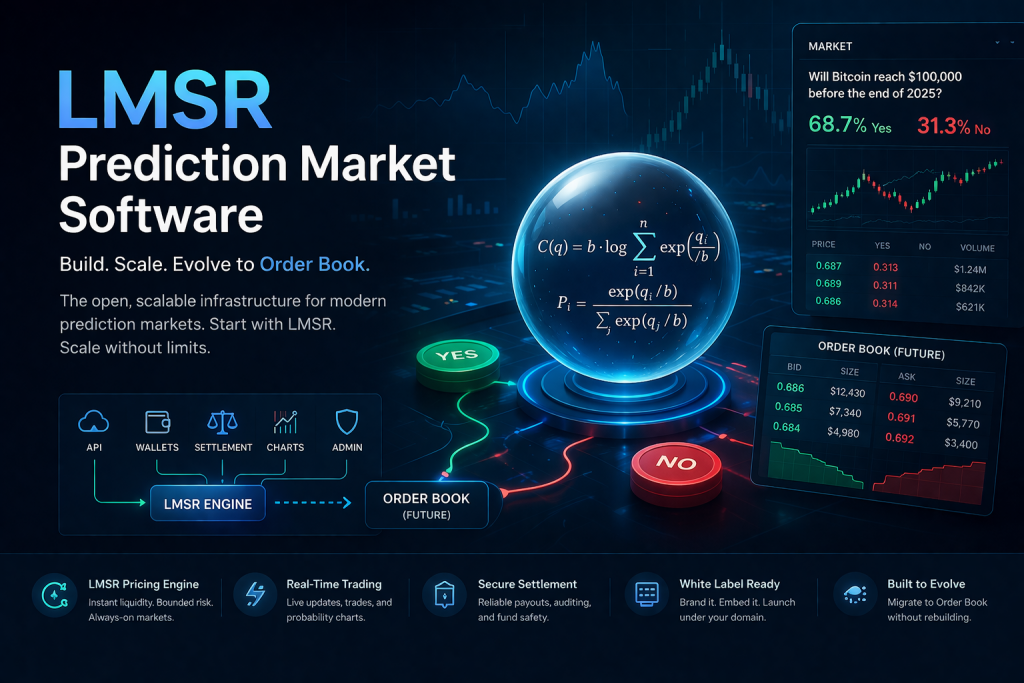
If you want to build serious prediction market software, understanding the LMSR formula is not enough. What matters is the full product architecture behind it: pricing, execution, wallet logic, settlement, charting, operator workflows, and the ability to scale beyond a simple MVP. That is where most projects fail. They treat market design like a math problem when it is really a platform design problem.
At the same time, Google’s current guidance is clear: content should be created for people first, titles should be clear and descriptive, URLs should use readable words, anchor text should help users understand linked pages, and AI-assisted content is not inherently a problem if the result is useful and original. In other words, to rank for terms like prediction market software or white label prediction market, you need an article that is both technically credible and commercially aligned.
What Is Prediction Market Software?
Prediction market software is the infrastructure that allows users to trade on the outcome of future events. Those events can range from elections and sports to macroeconomic releases, product launches, weather, or financial thresholds. In a serious platform, prices are not just decorative percentages; they function as live probability signals shaped by trading activity. Prediction market software therefore needs much more than a front-end interface. It needs market creation, outcome modeling, pricing logic, execution, fee handling, settlement, history, analytics, and operational controls.
That distinction matters because many founders start by asking, “Should I use LMSR or an order book?” The better question is: “How do I build a platform that can launch quickly today and still scale structurally later?” For most early-stage products, the answer starts with LMSR.
Why LMSR Is Such a Strong Starting Point
LMSR stands for Logarithmic Market Scoring Rule. Robin Hanson’s work made it one of the foundational automated market maker designs for prediction markets. In practical terms, LMSR gives you a bounded-loss, always-on market maker that can quote prices even when you do not yet have enough counterparties posting orders. That is exactly why LMSR is so attractive for new markets, thin markets, niche categories, and white-label deployments.
The core idea is elegant: the cost function increases logarithmically as inventory shifts across outcomes, and implied probabilities are derived from the relative exponential weights of those inventories. In plain English, users can trade immediately against the mechanism, and the mechanism updates price as demand changes. That gives a new platform something an order-book market often struggles to provide in its early days: instant tradability.
This is why LMSR prediction market software is often the smartest zero-to-one move. You do not need deep liquidity on day one. You do not need market makers constantly managing a book. You do not need users to wait for matching counterparties before activity starts. You can open the market, accept trades, update probabilities, and show motion immediately.
LMSR Is Not Just a Formula. It Is a Product Strategy.
A lot of technical founders frame LMSR as if it were only a pricing equation. That is too narrow. LMSR is a go-to-market strategy for prediction market platform development.
It helps you launch faster, reduce early liquidity friction, simplify execution, and validate demand before you take on the much harder problem of operating an efficient order-book environment. That trade-off is not hypothetical. Recent research comparing market scoring rules and continuous double auctions found that the relative price-discovery advantage depends in part on trading activity: when trade counts are high, continuous double auctions can perform better; when markets are thinner, scoring-rule mechanisms remain compelling.
That means the best architectural decision is usually not “LMSR forever” or “order book from day one.” The better decision is this:
Start with LMSR. Design for order-book migration.
What Real Prediction Market Software Actually Needs
If you want to build real prediction market platform development capability, your system should be modular. At minimum, the platform should have these layers:
1. Market Domain Layer
This is where you define markets, outcomes, states, positions, and settlement events. It answers fundamental questions: What is a market? What can be traded? What does a user own? When is a market open, locked, canceled, or resolved?
2. Pricing Layer
In an LMSR system, this layer computes prices, trade previews, slippage, fees, and cost changes. The critical design principle is separation: pricing logic should not be hard-wired into the presentation layer.
3. Execution Layer
This is where trade requests are validated, wallets are charged, positions are updated, records are written, and failures are recovered safely. A platform that handles real money or real user balances needs idempotency, locking, and rollback discipline.
4. Wallet and Settlement Layer
This is the part many weak products ignore. A real system needs payout logic, refund handling, settlement history, and auditable accounting. Without that, it is not infrastructure; it is a demo.
5. API Layer
A reusable API is what turns a one-off interface into an actual platform. It enables web apps, mobile apps, admin consoles, and future client-specific front ends.
6. Real-Time and Charting Layer
Prediction markets feel alive when prices move visibly. Live updates, trade history, and chart rendering are not cosmetic. They shape trust, retention, and operator confidence.
7. Operations and Admin Layer
A serious white label prediction market product needs operator workflows: create markets, manage outcomes, lock or resolve events, adjust visibility, and run content operations without requiring an engineer for every change.
Why Order-Book Readiness Matters From Day One
Here is the strategic mistake many teams make: they choose an LMSR-based MVP, but they design it so tightly around LMSR that the whole product becomes trapped inside that choice.
That is avoidable.
If your platform is well designed, the domain layer and settlement layer should survive a later migration. Markets, outcomes, user positions, payout rules, wallets, audit trails, and chart history do not need to be thrown away just because the execution mechanism changes.
What changes later is mainly the interaction model:
Today
- LMSR pricing
- Automated market maker
- Immediate execution against market inventory
Later
- Orders
- Fills
- Matching engine
- Bid/ask depth
- Partial fills
- Liquidity provider workflows
That is the architectural bridge founders should think about. You are not rebuilding the business domain. You are swapping the market interaction engine.
LMSR vs Order Book: Which One Is Better?
The honest answer is stage-dependent.
If you are launching a new product, validating a niche, bootstrapping liquidity, or selling a white-label system to clients who do not already have an active trader base, LMSR is usually the better choice. It is simpler to launch, easier to manage, and more forgiving in thin markets.
If you already have deep liquidity, high trade counts, active traders, and tighter price competition, an order book can become the stronger long-term structure. That is where price-time priority, visible depth, spread dynamics, and professional trading behavior start to matter more. Recent comparative work supports this more nuanced view rather than a one-size-fits-all answer.
So the right conclusion is not ideological. It is operational:
Use LMSR for launch speed and early usability. Use an order book when liquidity and market maturity justify the complexity. Design the platform so both paths remain open.
What White Label Prediction Market Really Means
A white label prediction market is not just a branded front end. A real white-label product lets different operators launch their own market experiences on top of the same core infrastructure while controlling branding, categories, workflows, fee rules, moderation, and deployment patterns.
That is why modular architecture matters so much. If your engine, API, admin tools, and execution logic are cleanly separated, you are not just selling custom development. You are building a reusable market infrastructure product. And that is a much stronger business.
Final Thoughts
If you are building prediction market software, the smart move is not to treat LMSR as a narrow mathematical trick. Treat it as the best practical starting point for launching a market that is usable before liquidity is deep.
LMSR works because it lowers friction. It lets users trade immediately. It helps a platform feel alive sooner. It reduces the operational burden of managing a fragile order book too early. And when it is paired with a modular architecture, it gives you something even more valuable: a realistic path from MVP to scale.
That is the real promise of modern prediction market platform development:
- start with LMSR
- separate pricing from execution
- build robust settlement and wallet flows
- expose reusable APIs
- support operator workflows
- stay ready for order-book evolution
That is how you build a prediction market platform that is not just launchable, but scalable, sellable, and strategically defensible.
